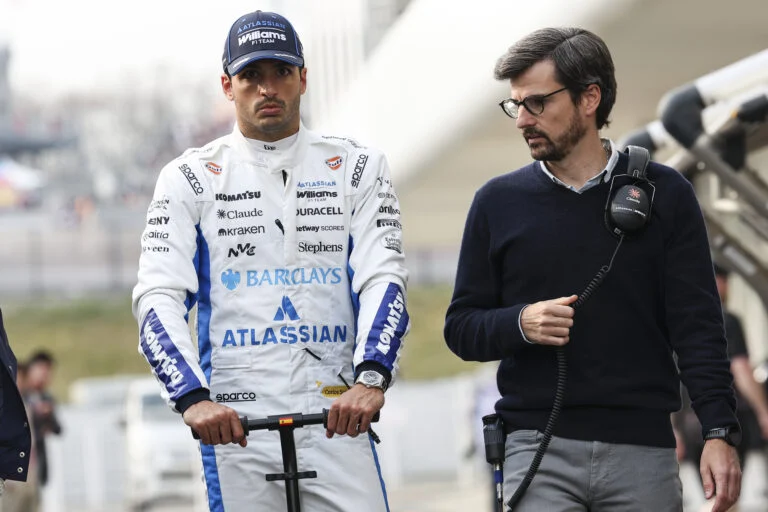
Carlos Sainz’s Formula 1 future has once again become a subject of intense speculation after reports emerged that his manager has begun reaching out to rival teams of Williams to initiate exploratory talks. The development comes at a crucial time in the 2026 season, as the driver market begins to heat up and teams quietly assess their long-term options.
 The Spanish driver, who joined Williams on a multi-year deal after leaving Ferrari, was initially seen as a cornerstone of the team’s rebuilding project. His arrival brought experience, race-winning pedigree, and credibility to a team eager to climb back toward the front of the grid. However, Formula 1 is a results-driven sport, and recent performances appear to have added a layer of uncertainty to his long-term commitment.
Reports indicate that Sainz’s management team has “knocked on the door” of competing outfits, signaling a proactive approach to understanding what opportunities might be available beyond Williams. This does not necessarily confirm an imminent exit, but it strongly suggests that contingency plans are being explored as the competitive order of the grid evolves.
One of the key factors behind this move is Williams’ inconsistent start to the 2026 season. While there have been flashes of progress, the team has struggled to consistently compete in the upper midfield, leaving Sainz in a position where podiums and victories remain distant goals. For a driver in the prime of his career, such limitations can be difficult to accept over the long term.
Despite these challenges, Williams team principal James Vowles has publicly maintained that Sainz remains committed to the project. He has emphasized that both Sainz and teammate Alex Albon are aligned with the team’s vision and motivated to push it forward. Yet, in Formula 1, public reassurance often coexists with behind-the-scenes maneuvering, especially during the early stages of a “silly season.”
Another important element in this situation is the existence of flexibility within Sainz’s contract. Previous reports have suggested that his deal may include clauses allowing him to leave if a top-tier opportunity arises. This kind of provision is common for high-profile drivers and gives Sainz leverage in a rapidly shifting market.
The interest from rival teams is also understandable. Sainz is widely regarded as one of the most consistent and technically astute drivers on the grid. His ability to adapt, provide detailed feedback, and extract performance from challenging machinery makes him an attractive option for teams looking to strengthen their lineup.
There are already whispers linking him to several top outfits, including the possibility of talks with leading teams should seats become available. While nothing concrete has been confirmed, the mere fact that his management is initiating contact suggests that Sainz wants to keep his options open rather than be locked into a long-term project that may take years to bear fruit.
At the same time, Sainz himself has previously expressed a desire to win races and compete for championships, even while showing loyalty to Williams. This dual ambition—commitment to a project versus the pursuit of immediate success—lies at the heart of the current situation and explains why his camp is actively exploring alternatives.
Ultimately, the coming months could prove निर्णisive. If Williams continues to show tangible progress and closes the gap to the front, Sainz may be convinced to stay and lead the team into a new era. However, if performance stagnates and stronger offers materialize, the groundwork being laid now by his manager could pave the way for a high-profile move.
For now, the situation remains fluid. What is clear, however, is that Carlos Sainz is once again at the center of Formula 1’s ever-turning transfer carousel, with his future likely to be one of the defining stories of the upcoming driver market.