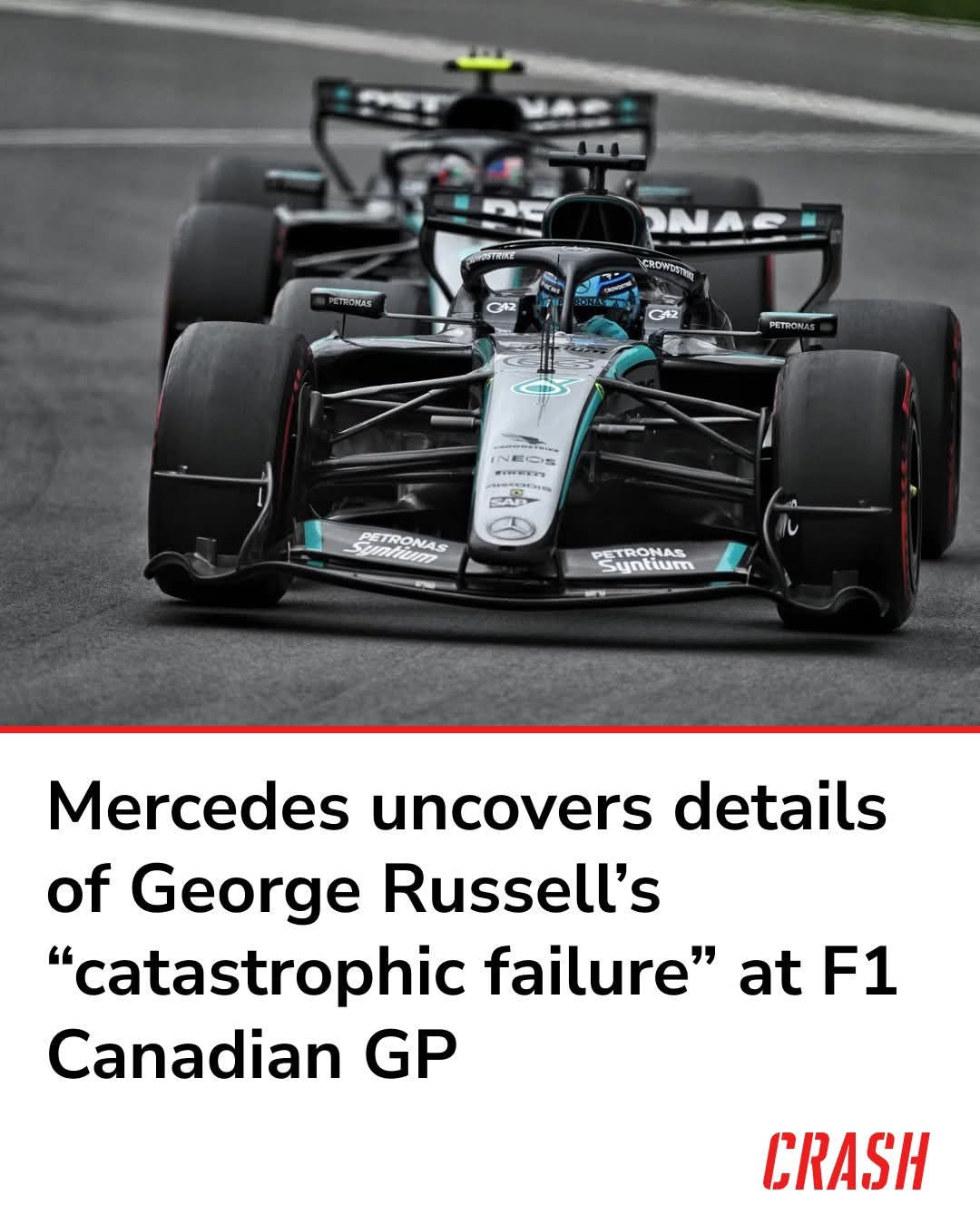
George Russell’s Canadian Grand Prix heartbreak has now been fully explained by Mercedes, and the timing could not have been worse for the British driver’s fading 2026 Formula 1 title hopes.
After an intense wheel-to-wheel battle with teammate Kimi Antonelli in Montreal, Russell looked poised to deliver one of the most important victories of his career before disaster struck on lap 30. Leading the race and fighting aggressively to keep Antonelli behind, Russell suddenly slowed to a halt after a catastrophic power unit issue ended his afternoon in dramatic fashion.
Now, Mercedes has confirmed the exact cause of the failure — and it paints a worrying picture for a team trying to balance championship ambitions with reliability concerns during the first season of Formula 1’s new regulation era.
According to Mercedes technical chief James Allison, the retirement was triggered by a catastrophic battery failure that completely shut down Russell’s car mid-race. The issue immediately killed the engine and destroyed what had been shaping up as a defining performance in Russell’s campaign.
“It was an engine kill caused by a failure in the battery,” Allison explained during Mercedes’ post-race debrief. “The battery suffered a catastrophic failure a third of the way into the race and brought George’s race to an end there.”
The Mercedes boss admitted the team discovered visible heat damage after the race and confirmed an internal investigation is already underway to determine exactly why the system collapsed under race conditions. In a season where reliability margins are already razor-thin due to the aggressive 2026 power unit regulations, the incident raises fresh questions about whether teams are pushing too close to the limit.
For Russell, the consequences are massive.
Instead of leaving Canada with a statement victory, the Brit watched Antonelli cruise to a fourth consecutive win and stretch his championship advantage to 43 points. It was another painful blow in what Russell described as a season full of cruel setbacks.
After the race, the Mercedes driver delivered one of his most emotional interviews of the year.
“Right now it’s his to lose,” Russell admitted. “It feels like the gods don’t want me to be in this fight.”
The frustration was understandable. Russell has already endured poor timing with safety cars, qualifying failures, and mechanical issues in key moments this season. Canada may have been the breaking point psychologically because, unlike previous disappointments, this one happened while he was controlling the race from the front.
Yet despite the heartbreak, the Canadian Grand Prix may also have revealed something bigger inside Mercedes — the beginning of a genuine internal war between Russell and Antonelli.
Their battle in Montreal was arguably the fiercest teammate fight Formula 1 has seen since Lewis Hamilton and Nico Rosberg’s explosive rivalry at Mercedes over a decade ago. The pair traded positions repeatedly, pushed each other into mistakes, and refused to back down even for a moment.
Antonelli twice found himself forced onto the grass while trying to attack Russell, and the Italian teenager openly complained over team radio about some of Russell’s defensive driving. Still, the 19-year-old showed maturity beyond his years by recovering calmly and eventually inheriting victory after Russell’s retirement.
The bigger concern for Mercedes now is obvious: how long can Toto Wolff allow this battle to continue without intervention?
Russell’s aggressive defending showed he understands the danger Antonelli represents. This is no longer a rookie learning his craft. Antonelli is already driving like a championship leader, and perhaps even more concerning for Russell, he appears mentally unfazed by the pressure.
Canada exposed that reality clearly.
Even on a circuit traditionally considered one of Russell’s strongest tracks, Antonelli looked capable of matching him pace for pace. The teenager’s confidence continues to grow, and with every victory, the psychological balance inside Mercedes shifts further in his favour.
From a wider Formula 1 perspective, the race also strengthened arguments that the 2026 regulations may actually be creating better racing than many originally feared.
Drivers struggled for grip throughout the weekend, mistakes became common, and the unpredictable conditions created constant action. Russell himself praised the current generation of cars and engines after the race, insisting the close racing between him and Antonelli proved the regulations are working.
“I haven’t had a battle like this in years,” Russell said. “These new cars allow you to do that. These new engines allow you to do that.”
That comment is especially interesting given the growing political pressure inside Formula 1 to potentially move away from the current engine philosophy in the coming years. Some drivers, including Max Verstappen, have criticized the new power units heavily, while others believe the unpredictability and tighter racing have improved the spectacle significantly.
Canada certainly delivered chaos, tension, and drama — three ingredients Formula 1 desperately needs.
And while Antonelli left Montreal as the championship’s clear favorite, Russell’s retirement may become remembered as the moment Mercedes’ internal rivalry truly exploded into life.
The season is still young, but momentum in Formula 1 can change rapidly. If Mercedes solve their reliability concerns and Russell begins converting pace into victories again, this title fight could become one of the most intense teammate battles the sport has seen in years.
But after Canada, one reality is impossible to ignore.
Kimi Antonelli is no longer the future of Mercedes.
He is the present.