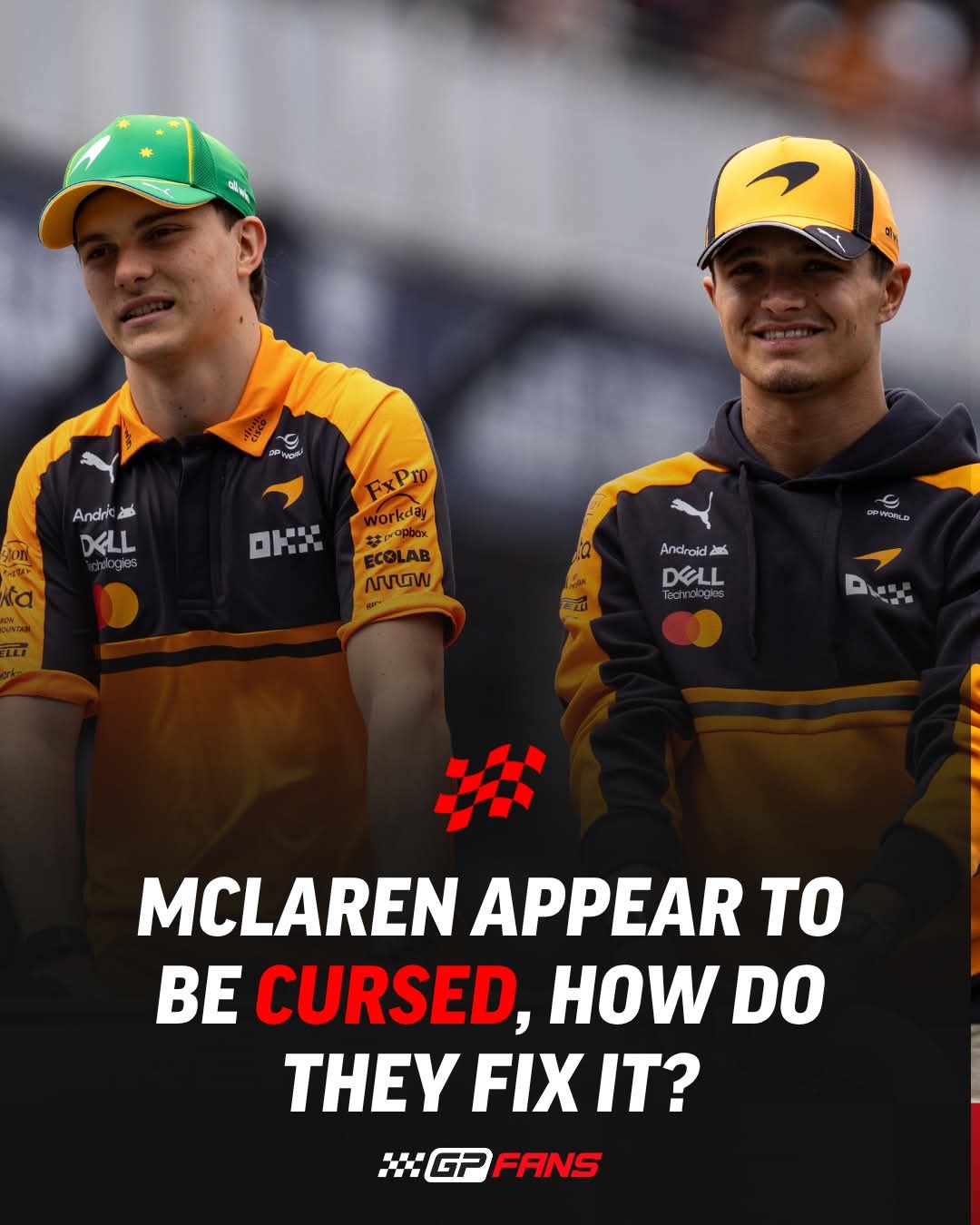
McLaren’s title defense was supposed to begin with momentum, confidence, and the swagger of back-to-back Constructors’ Championships. Instead, the opening phase of the 2026 Formula 1 season has felt like a bizarre collection of disasters, strategic heartbreak, and costly setbacks. Whether fans call it bad luck, poor timing, or a racing curse, one thing is becoming increasingly difficult to ignore: McLaren’s season has repeatedly unraveled before races have even fully begun.
For a team that entered the year with championship expectations, the numbers tell a concerning story. Despite possessing a car that has shown flashes of serious speed, McLaren has seen five of its first ten races compromised by circumstances ranging from reliability failures to strategy miscalculations and race-day chaos. In Formula 1, where every point can determine championships, those missed opportunities may become painful later in the season.
McLaren Has Pace But Not Stability
One of the strangest aspects of McLaren’s difficult start is that outright speed does not appear to be the biggest problem.
The team remains one of the strongest operations in Formula 1. Team principal Andrea Stella is respected throughout the paddock for his technical understanding and leadership qualities. CEO Zak Brown has overseen one of the sport’s most impressive organizational rebuilds in recent years. Their back-to-back Constructors’ Championships did not happen by accident.
On pure performance, the car has often looked capable of competing near the front.
That is what makes the situation increasingly frustrating.
Australia immediately delivered early disappointment after Oscar Piastri suffered an unusual incident while heading toward the grid. China created even greater headaches when electrical problems affected both cars, eliminating valuable opportunities before the race could properly unfold.
Japan introduced another cruel twist when a poorly timed safety car damaged Piastri’s chances of victory. Then Canada brought yet another painful chapter. McLaren gambled on intermediate tyres, anticipating rainfall that never arrived in the expected manner.
The decision immediately backfired.
Both Lando Norris and Oscar Piastri found themselves returning to the pits within the opening laps to abandon the strategy. Piastri later suffered front-wing damage after contact, while Norris eventually encountered mechanical issues that destroyed his race entirely.
Individually, these incidents might simply represent bad fortune.
Collectively, they create a pattern.
Why McLaren’s Problems May Go Beyond Bad Luck
The humorous idea of a “curse” surrounding McLaren has naturally gained traction among fans because Formula 1 often develops strange narratives around repeated misfortune.
But beneath the jokes lies a serious discussion.
McLaren enters this regulation cycle as a customer team rather than a full manufacturer operation. Unlike Mercedes or Ferrari, who build both chassis and power units together, McLaren relies on externally supplied engines.
That difference matters.
Manufacturer teams can align development philosophies more closely because every component evolves under one organizational structure. Customer teams sometimes face additional challenges adapting rapidly to changing technical environments.
That does not automatically mean McLaren cannot succeed. They already proved that through recent championship success.
However, under fresh regulations, even small disconnects can create larger performance complications.
Strategy Errors Continue Raising Questions
The Canadian Grand Prix also reopened discussions regarding McLaren’s race strategy department.
Formula 1 increasingly rewards teams capable of processing enormous amounts of data in real time. Weather forecasts, tyre degradation models, track temperatures, and safety car probabilities all influence split-second decisions.
When those calls work, teams look brilliant.
When they fail, criticism becomes unavoidable.
Starting both cars on intermediate tyres in Canada represented a high-risk gamble. Had weather conditions shifted differently, McLaren might have looked like strategic geniuses.
Instead, they looked unprepared.
Championship-winning teams usually minimize these kinds of repeated mistakes.
The concern for McLaren is not necessarily one bad decision — every team experiences those moments. The concern is whether multiple setbacks begin creating a loss of confidence internally.
Analysis: Is McLaren Actually in Trouble?
Despite recent struggles, writing off McLaren would be premature.
The team has already demonstrated its ability to recover from difficult situations.
Perhaps the most important statistic comes from recent history itself. During the 2024 season, McLaren faced a significant points deficit against Red Bull with seventeen races remaining. Not only did they erase that gap, but they eventually turned it into a championship advantage.
Formula 1 seasons can change rapidly.
Upgrades arrive.
Momentum shifts.
Reliability improves.
And teams learn from mistakes.
The early phase of a regulation era often rewards organizations capable of adapting quickly rather than those who simply start strongest.
McLaren has already proven they possess that capability.
Prediction: McLaren Could Still Become Mercedes’ Biggest Threat
While the opening half of 2026 has felt chaotic, there remains enough time for McLaren to reverse the narrative completely.
If the team continues developing what appears to be a fundamentally fast package, many of these problems could gradually disappear. Reliability concerns can be solved. Strategic processes can improve. Operational weaknesses can be corrected.
Speed is usually the hardest thing to find.
McLaren may already have that part.
The larger challenge now involves eliminating the costly mistakes and strange setbacks that have repeatedly derailed race weekends.
Because if those issues finally disappear, the so-called curse may suddenly look a lot less supernatural—and a lot more like a championship contender rediscovering its rhythm.
For now, McLaren’s season feels like chaos. But Formula 1 history has repeatedly shown that chaos and comebacks often travel together.