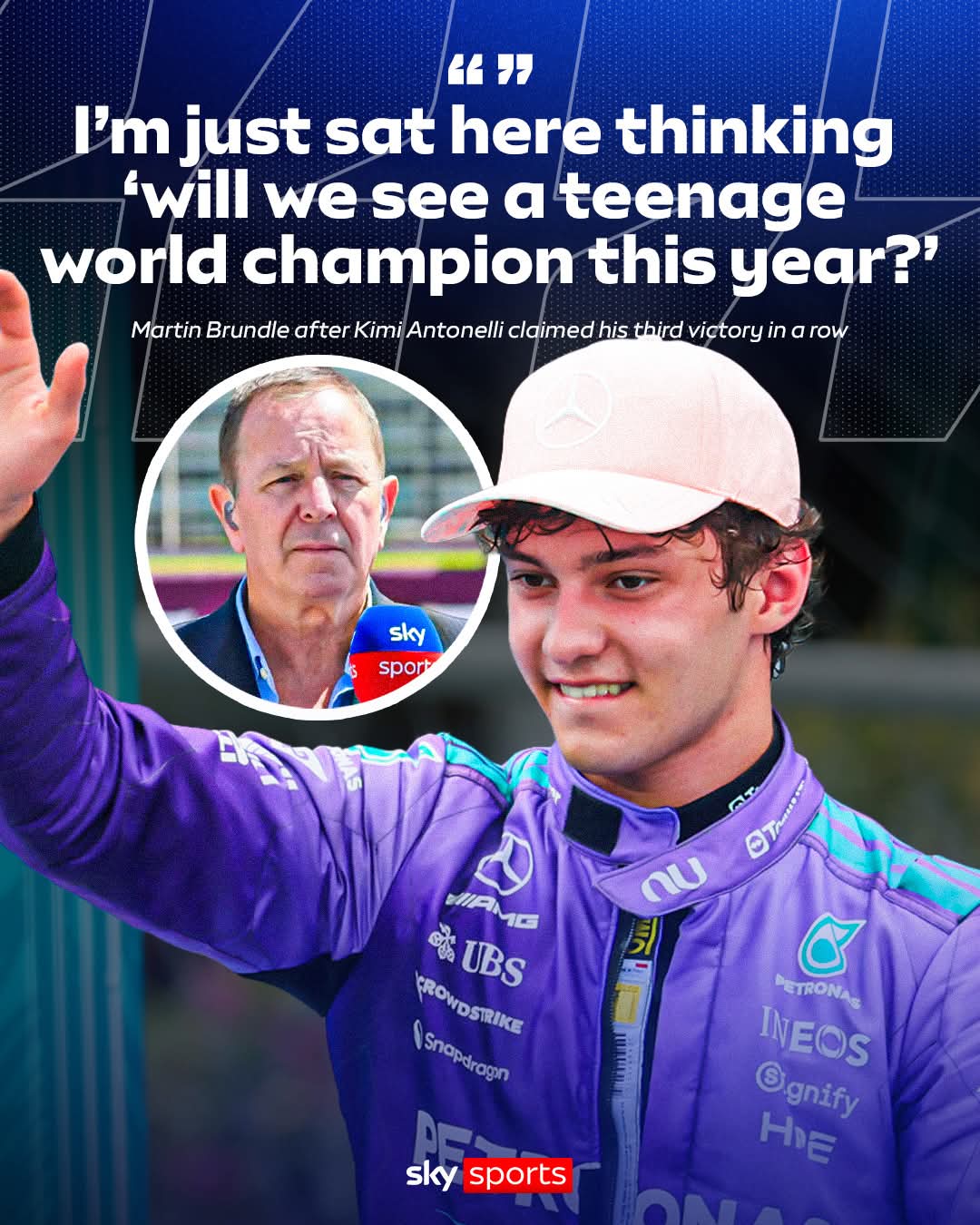
“I’m just sat here thinking — will we see a teenage world champion this year?”
That remark from Martin Brundle captures a growing buzz around one of motorsport’s most exciting emerging talents: Kimi Antonelli. After securing his third consecutive victory, Antonelli has ignited conversations that go far beyond race wins—they’re about history, legacy, and whether Formula 1 is on the brink of a generational shift.
—
The Rise of Kimi Antonelli: More Than Just Hype
Antonelli isn’t just another promising junior driver—he’s rapidly becoming the face of a new era. Dominating in feeder series with remarkable consistency, racecraft, and composure, he’s demonstrating qualities typically associated with far more experienced drivers.
Winning three races in a row is no small feat in highly competitive junior categories. It signals:
Elite adaptability across circuits
Mental resilience under pressure
Strategic intelligence beyond his years
These are precisely the traits that separate good drivers from potential champions.
—
Why the “Teenage Champion” Question Matters
The idea of a teenage world champion isn’t new—but it’s rare. The benchmark was set by Sebastian Vettel, who became the youngest F1 World Champion at age 23. Since then, Formula 1 has trended toward slightly older champions due to increased competition, longer development cycles, and the complexity of modern cars.
So when Brundle raises the possibility of a teenage champion, he’s really asking:
Has driver development accelerated enough to fast-track prodigies?
Are teams more willing to take risks on youth?
Is the current grid vulnerable to disruption?
—
The Perfect Storm: Why It Could Happen Now
Several factors make this moment uniquely suited for a young breakthrough:
1. Driver Development Pipelines Are Stronger Than Ever
Programs run by teams like Mercedes-AMG Petronas Formula One Team are producing drivers who are F1-ready earlier than ever. Antonelli, a Mercedes junior, is a prime example of this polished pipeline.
2. Simulator Technology and Data Access
Young drivers today grow up with advanced simulators and telemetry analysis, accelerating their learning curve dramatically compared to past generations.
3. Changing Team Philosophies
Teams are increasingly prioritizing long-term investment over short-term stability. This opens doors for teenagers to enter F1 earlier—and succeed faster.
—
Reality Check: What Stands in the Way?
While the excitement is justified, turning teenage promise into a world championship is an entirely different challenge.
F1 entry barriers remain high: Even exceptional juniors must secure a seat in a competitive team.
Car performance still dominates: Talent alone doesn’t win championships—machinery matters.
Pressure at the top level is relentless: Media scrutiny, expectations, and consistency over a full season are brutal tests.
Even generational talents need time to adapt.
—
Expert Perspective: What Brundle Is Really Saying
Brundle’s comment isn’t a prediction—it’s a signal. It reflects how unusual Antonelli’s trajectory is and how seriously the paddock is starting to take him.
When seasoned analysts begin asking these questions, it usually means:
The talent is undeniable
The trajectory is steep
The timeline may be shorter than expected
—
Prediction: Is a Teenage Champion Actually Likely?
Let’s be realistic—this year? Highly unlikely.
Antonelli hasn’t yet fully transitioned into Formula 1, and even if he does soon, winning a championship immediately would require an extraordinary alignment of circumstances.
However…
Within the next 3–5 years? Absolutely possible.
If Antonelli:
Lands in a top-tier team early
Continues his current rate of development
Avoids major setbacks
Then he could genuinely challenge records—and perhaps redefine what’s considered “too young” in Formula 1.
—
Final Thoughts: A Generational Shift in Motion
Whether or not a teenage champion emerges this season, the conversation itself is telling. Drivers like Kimi Antonelli are forcing the sport to reconsider its assumptions about age, readiness, and potential.
Brundle’s question might not have an immediate answer—but it highlights something bigger:
Formula 1 is entering a new era where youth is no longer a limitation—it’s an advantage.
And if Antonelli’s current form is any indication, the future might arrive sooner than anyone expected.